 |
BEAR (Balloon Experiments with Amateur Radio) |
||
 |
|||
|
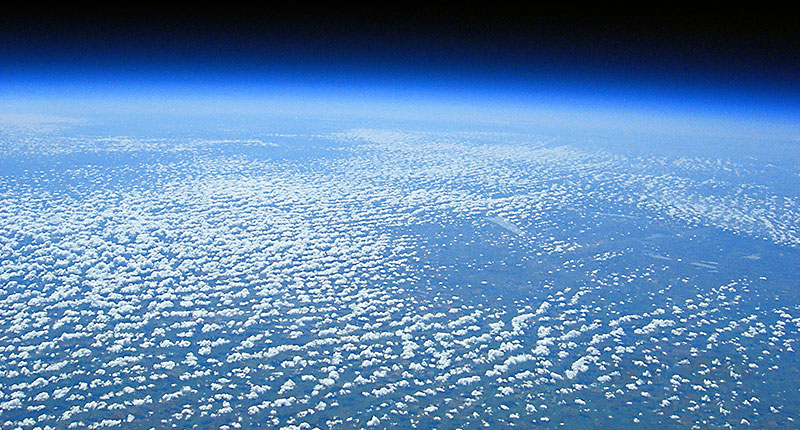
A view from near space and SABLE-3 at 117,597 feet, August 11th - 2007 |
|||
|
Near space is within the Stratosphere and Ozone layers from 75,000 feet to the beginning of space at 62.5 miles. The earth's curvature and thin blue layer of atmosphere hugging the earth can easily be seen from here and at 117,000 ft. the horizon is at 460 miles, rather then only 2-3 miles when standing at ground level. The air pressure is <1% of that at sea level and with so little atmosphere there is next to no filtering of cosmic rays or ultraviolet light, blue sun light is not scattered leaving the sky inky black, stars are visible, and there is no weather so it's always bright and sunny, but very cold at -60 to -90 degrees Fahrenheit. A few friends and myself decided to start launching HAB (High Altitude Balloon) payloads with amateur radio, camera and other equipment which we nicknamed BEAR (Balloon Experiments with Amateur Radio) after watching others do this and seeing no reason why they should have all the fun. We are not a club or official group, but simply a few amateur radio operators with similar interests, a common goal and hope that our BEAR projects, which anyone is welcome to participate in, will help promote education, experimentation and camaraderie between all amateurs and amateur radio clubs in the area. An APRS tracker is essential to track and recover balloon payloads and our first flight, BEAR-1, was to confirm the GPS receiver we chose for our tracker would work above the 60,000 ft. ITAR altitude limit. BEAR-2 included a cross-band repeater and future flights are planned with cameras and other equipment. August 2009 - It's been 9 years since BEAR-2 and some have asked if the BEAR group is still active. It is, but it's not an official group and simply myself that enjoys building the payloads, a few others that enjoy helping launch, track and recover them and a often a few more that enjoy simply watching. Progress is slow with only myself building the payloads, especially with all the other projects and things I also like to do, but progressing slowly has been good. Digital cameras were just starting to become available and much too expensive for any of us to risk using in 2000, but have become fairly inexpensive and capable of much higher resolution images now. And video cameras used to not only be too expensive, but too large, heavy and have very short recording times, but have now become much smaller, lighter weight, inexpensive and have much longer recording times now plus it's even become possible to transmit real time video from one aboard a high altitude balloon flight. |
| Date | Flight | Special Notes |
Duration H:M |
Max. Alt. Feet |
Balloon | Total Payload (+) | Distance Travelled | ||
| Kg | Lbs | Point to Point | Ground Path | ||||||
| May 27, 2000 | BEAR-1 | 1st Flight | 4:34 | 104,206 | 1200g (1) | 0.977 Kg | 2.15 Lbs | 76.2 Miles | 106.8 Miles |
| Aug 5, 2000 | BEAR-2 | 2:48 | 99,481 | 1200g (1) | 1.564 Kg | 3.45 Lbs | 53.8 Miles | 71.1 Miles | |
| May 20, 2006 | SABLE-1 |
Visit the SABLE Home Page for these and other SABLE flights |
|||||||
| July 8, 2006 | SABLE-2 | ||||||||
| August 11, 2007 | SABLE-3 | ||||||||
| May 20088 | TBJ 2008 |
TBJ - The largest balloon launch most of us could ever hope to be involved with. |
|||||||
| Aug 22, 2009 | BEAR-3 | 2:39 | 116,387 | 1500g (2) | .0958 Kg | 0.21 Lbs | 47.7 Miles | ||
| Aug 24, 2009 | BEAR-4 | HD Video | 3:56 | 107,145 | 1200g (2) | 1.500 Kg | 3.31 Lbs | 89.0 Miles | |
| April 24, 2010 | BEAR-5 | 1st UofA | 2:51 | 92,359 | ≈2000g (2) | 0.228 Kg | 0.50 Lbs | 14.1 Miles | 41.5 Miles |
| May 16, 2010 | TBJ 2010 |
We were once again at TBJ to help with tracking and recovery operations, |
|||||||
| BEAR-6 | 2:23 | 114,635 | 1000g (1) | 0.370 Kg | 0.82 Lbs | 33.7 Miles | 42.1 Miles | ||
| May 29, 2010 | SABLE-4 | 3:14 | 110,219 | 1500g (1) | 0.772 Kg | 1.70 Lbs | 61.1 Miles | 83.5 Miles | |
| July 8, 2010 | BEAR 7 | UofA | 1:59 | 93,917 | 1000g (1) | 1.420 Kg | 3.13 Lbs | 34.5 Miles | |
| July 15, 2010 | BEAR 8 | UofA | 1:47 | 91,952 | 1000g (1) | 1.986 Kg | 4.38 Lbs | 40.0 Miles | 52.6 Miles |
| Oct 2, 2010 | ABE-1 | 103,533 | 1200g (1) | ||||||
| May 14, 2011 | ABE-2 | 99,770 | 1200g (1) | ||||||
| June 18, 2011 | SABLE-5 | 1500g (1) | |||||||
| Feb 11, 2012 | BEAR-9 | 4x5 #1 | 2:44 | 118,146 | 1600g (3) | 2.2 Kg | 4.85 Lbs | 31.2 Miles | |
| Feb 13, 2012 | BEAR-10 | 4x5 #2 | ?? | ?? | 1600g (3) | 2.1 Kg | 4.63 Lbs | 19.1 Miles | |
| May 15, 2013 | BEAR-11 | 4x5 #3 | 2:12 | 118,195 | 1600g (3) | 3.0 Kg | 6.61 Lbs | ||
| May 17, 2013 | BEAR-12 | 4x5 #4 | 2:17 | 121,633 | 1600g (3) | 2.8 Kg | 6.17 Lbs | ||
| May 20, 2013 | BEAR-13 | 4x5 #5 | 2:46 | 121,525 | 1600g (3) | 2.8 Kg | 6.17 Lbs | ||
| Aug 24, 2013 | BEAR-14 | Genesis #1 | 100,443 | 1200g (2) | 67.9 Miles | ||||
| Jan 18, 2014 | BEAR-15 | Genesis #2 | 101,742 | 1200g (2) | 150 Miles | ||||
| Sept 6, 2014 | BEAR-16 | Genesis #3 | 2:10 | 100,925 | 1500g (2) | 76 Miles | |||
| Sept 14, 2014 | BEAR-17 | Genesis #4 | 103,772 | 1500g (2) | ≈ 88 Miles | ||||
| Sept 21, 2014 | BEAR-18 | Genesis #5 | 1:36 | 99,665 | 1500g (2) | 64.3 Miles | |||
| Sept 28, 2014 | BEAR-19 | Genesis #6 | 2:00 | 101,151 | 1500g (2) | 53.5 Miles | |||
| June 27, 2015 | BEAR-20 | Jacob’s Wish | 1500g (2) | 42 Miles | |||||
| Aug 27, 2016 | BEAR-21 | Grow Your Own Project |
2:06 | 88,850 | 1500g (2) | 42 Miles | |||
| Aug 26, 2017 | BEAR-22 | Grow Your Own Project |
2:14 | 104,029 | |||||
| ??? | BEAR-23 | Up Coming | |||||||
| ??? | BEAR-24 | ||||||||
| Notes: | (1) Kaymont Balloon with Helium (2) Kaymont Balloon with Hydrogen (3) Hwoyee Balloon with Hydrogen (+) Total Payload Weight includes all payload packages, parachute and connecting lines. |
||||||||
| We've been using Hydrogen that cost's ≈$60/bottle since 2008 when the cost of Helium rose to $280 from $80/bottle (other than when helping schools and other groups with a flight that purchased or had Helium donated). |
|||||||||



Information and pages on this site © Copyright 2004 by Barry Sloan - VE6SBS