Radio Shack HTX-404 Defect
|
|
| Here are the results of my investigation into why the Edmonton IRLP node can not be accessed using a Radio Shack HTX-404 handheld UHF radio due to DTMF tone problems. The Edmonton UHF IRLP node requires the use of a 103.5 Hz CTCSS tone for repeater access and when the repeater receives a DTMF tone from a HTX-404 it will drop out momentarily for approximately 200ms after receiving each tone before continuing on and repeating the remainder of the tone transmission. The repeater also drops out momentarily after the end of each DTMF tone transmission and the drop outs are due to the repeater CTCSS decoder momentarily losing CTCSS tone input at the start and end of each HTX-404 DTMF tone transmission. The CTCSS tone decoder output is used by the IRLP interface for the receiver COS signal in order to keep repeater hang time, courtesy tones, and I.D.'s from being transmitted over the IRLP system and, as a result, what the IRLP interface receives when a HTX-404 is used to enter the 4 digit IRLP access code, is 8 individual single tone transmissions. |
|
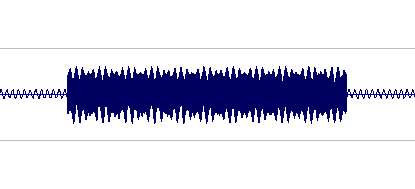 |
This is a recording representative of DTMF tones received from several different handheld and mobile radios that I have. All recordings are of a DTMF tone of 3.5 kHz deviation with a 103.5 Hz CTCSS tone of 600 Hz deviation. |
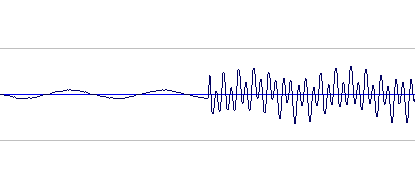 |
Zooming in closer shows that there's a nice clean transition from receiving CTCSS only to CTCSS + DTMF tone. |
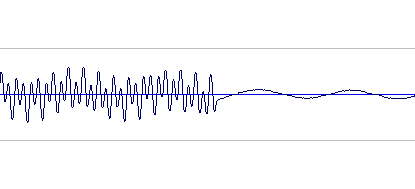 |
There's also a nice clean transition at the end of each tone when transitioning from DTMF + CTCSS to just the CTCSS tone. |
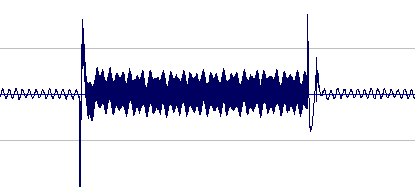 |
However this recording of a DTMF tone received from a HTX-404 radio is very different and shows that there is an extreme modulation swing at the start and end of each DTMF tone. |
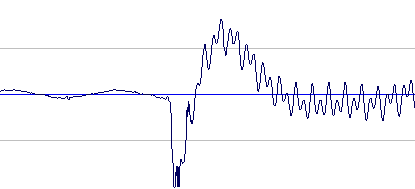 |
The transition from CTCSS only to CTCSS + DTMF tone results in a deviation of more than -15 kHz and then +12 kHz before returning within the normal 5 kHz bandwidth of a receiver. |
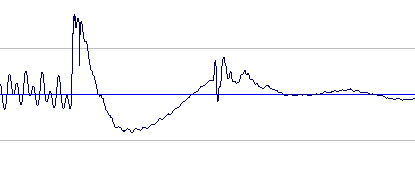 |
And the return transition from DTMF + CTCSS tone to only CTCSS tone results in a deviation of about +12 kHz and then -5 kHz before returning to normal. |
|
It's now obvious that the receiver CTCSS decoder is dropping out due to the receiver being unable to supply a CTCSS tone during the period that the HTX-404 is transmitting an over deviated signal and a similar CTCSS decoder in the IRLP link radio reacts the same way to HTX-404 DTMF
tones. Several amateur transceivers have been found to tolerate the HTX-404 signal much better, but also occasionally drop out. The repeater and link radio CTCSS decoders could be possibly modified to accept longer CTCSS signal drop outs, but this would increase the system turn around time which
is unacceptable. CONCLUSION: |
|
|